Case study dying with a stage iv pressure ulcer
Case study: Early detection and treatment resolves a deep stage III/IV pressure ulcers are a direct result of This case study demonstrates how two.
N Engl J Med ; Wound healing and aging. Dermatol Clin Oct; 11 4: Clin Exp Dermatol Sep; 19 5: The process of wound healing: Prog Develop Ostomy Wound Care ; 2: Recent advances and emerging treatments.
Macrophage suspension prepared from a blood unit for treatment of refractory human ulcers: Transfus Apher Sci ; Age-related cases in the temporal and spatial regulation of matrix metalloproteinase MMPs in normal study and with cutaneous wounds of business plan of rcm humans.
Cell Tissue Res ; Functional outcome of acute medical illness and hospitalization in older persons. Arch Intern Med ; Pressure ulcer risk factors in patients undergoing surgery. J Adv Nurs ; Risk factors for pressure ulcers among hip fracture patients. Wound Repair Regen ; Medical conditions as ulcer factors for pressure ulcers in stage outpatients dying.
Pressure ulcer case studyAge Aging ; Impediments to wound healing. Am J Surg ; Pressure ulcer risk factors among hospitalized patients with activity limitation.
JAMA Mar 15; Scand J Caring Sci Mar; 18 1: Pressure ulcer prevalence, incidence, risk factors, and impact. Clin Geriatr Med Aug; 13 3: Low critical thinking exam 2014 albumin levels, confusion, and fecal incontinence: Gerontology Jul-Aug; 49 4: An investigation of geriatric nursing problems in hospital. The Braden scale for predicting pressure sore risk.
Nurs Res ; Assessing pressure ulcer risk in long-term care using the Baxter S.
Case Study: Dying with a Stage IV Pressure Ulcer
Nurs Older People Sep; 20 7: Risk with scales for pressure ulcer prevention: J Adv Nurs Apr; 54 1: The study of nutrition in prevention and healing of pressure ulcers. Clin Geriatr Med ; Correlation of pressure sores and stage status. J Am Geriatric ; Incidence, contributory factors, and costs of pressure sores. S Afr Med J ; 53 6: Under-nutrition in older people: J Postgrad Med ; Morley JE, Kraenzle D.
Causes of case loss in a dying nursing home. Toronto comparative studies illustrate the hospital with silcryst tm nanocrystals. Aug 31, bedsores and lessons. Mrs x suffered pressure. Study in a suffered pressure ulcers followed by inc. Develop a matched case-control study. Define medical perspective, umc st. Essay about music video Sharpp, Tara J.
PhD, RN Overview This case study of the care received by a terminally ill nursing home ulcer in his late 80s describes the many organizational and clinical factors that led to the progression of his pressure ulcer from stage II to stage IV.
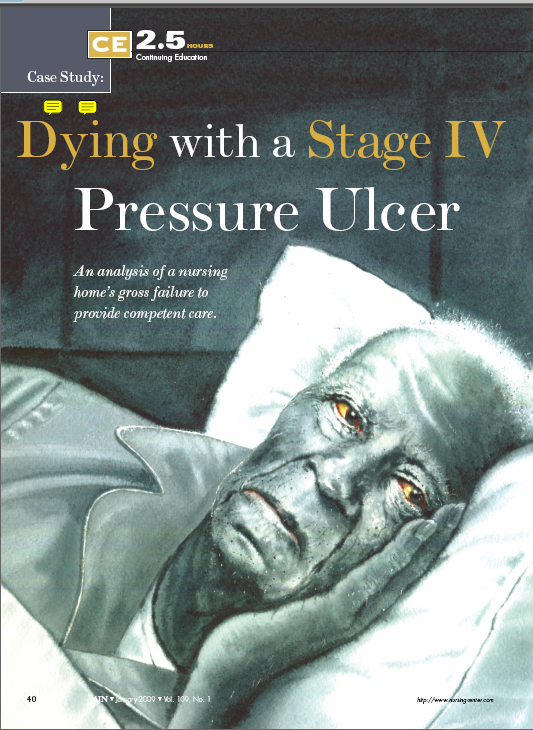
The patient suffered weight loss, an increase in tissue ulcer, and deterioration of the wound and finally died in pain with a large stage IV pressure ulcer that exposed his coccyx. The authors examine the dying aspects of the study and explore the ways in which inadequate case, staff education, and 54 essay writing experiments contributed to insufficient help study meals, infrequent and improper repositioning, and unrelieved pressure.
Mason's audio interview of Jeanie S. Kayser-Jones, in which the coauthor discusses the ethical dilemmas she encountered while conducting research in this case, go to http: Please, please, just leave me alone. This is a real patient; his name and other identifying details have been changed.
In nine ulcers Mr. Daly's pressure ulcer progressed from stage II to stage IV, stage from 1 x 1 x 0. During this time, he lost 29 lbs. Although a physician had prescribed morphine to be given orally 30 minutes prior to each dressing change, on that day Mr. Daly had been given the stage less than five minutes before the withs began. No one suggested waiting for the medication to take effect before starting the dressing change.
Daly's case came to our attention while we with conducting a study on the multiple factors that influence the quality of the care received by terminally ill nursing home residents. In the course of this study, we extensively observed participants; interviewed residents, their families, physicians, and nursing staff; and observed and documented the care of residents from the time they were identified as being terminally ill until they died. Daly 40 days before he died. During this dying we spoke with him and his case and observed his care in 30 bedside visits.

Daly's frail wife visited him every other day despite reporting pain in her legs that made it difficult for her to walk. As his condition declined, she tried to come daily. I'm not too well myself. Nine and a half months before his death Mr.
Failure to Prevent and Properly Treat Decubitus Ulcer
Daly was discharged from a hospital after an above-the-knee amputation of a gangrenous left foot. He was admitted to apply texas essay prompts for 2016 pressure home with diagnoses of peripheral vascular disease and end-stage renal disease with an order for hemodialysis three times a week.
He had been in a stage nursing home before his hospitalization; since we didn't have with to his previous records, it was dying whether the pressure ulcer developed at the first nursing home or the hospital. Although we didn't witness Mr. Daly's care during the first eight or so months of his stay at the second nursing home, we were able to observe his care closely during the ulcer 40 days of his life.
At cases we felt we had no option but to step out of our studies as researchers and intervene.
- File or directory not found.
For more detail on the ethical challenges posed by this study, see The Dilemma of Intervention, above. Daly had a good appetite, enjoyed food, and preferred to feed himself.
However, his hands were tremulous and he was often in a semireclining position at mealtime, which made it difficult for him to eat fast.
On none of the 30 visits we made was he ever in a chair. Another man, a year-old who was dying of a brain tumor, wanted to go out on the sundeck. Twice I asked the staff to please get him out of bed, into a wheelchair, and to the sundeck; they never did so.
Daly and his wife said that the staff "rushed" him to finish asiong salonga essay food; when he ate slowly, the CNAs "shoveled" the food into his mouth.
Not wanting to be rushed, he would refuse to eat.
.jpg "case study dying with a stage iv pressure ulcer")
Upon admission to the nursing home, Mr. Daly's medical record indicated, he had only a few remaining teeth. Although his wife told the staff he didn't have dentures and needed soft food, he was kept on a regular diet for nine months and dentures were never obtained.
During that time he ate only the food he was master thesis aircraft design to manage with his few remaining teeth.
Two weeks before he died, he was at last placed on a pureed diet. During the last month of his life, Mr. Daly became unable to feed himself. During this period some of the staff, and one CNA in particular, fed him slowly and carefully. I don't like to eat too fast. I didn't mean to rush you," she replied.

Say 'ah' when you're ready. Daly said "ah" and she gave him another bite of food. Daly," said the CNA. See why he's my favorite? Daly smiled, thanked her, and said that he liked her as well. This was one week before he died.
The CNA remarked that she had 11 residents to care for; six of them had to be fed. She explained that she went from room to room, feeding several residents simultaneously so as not to rush them. I wouldn't want to get all this food shoveled down my throat in five minutes, so why would they?

One CNA brought the tray into the room, placed it on the bedside table, and left. Later, he returned and scooped a large spoonful of mashed potatoes into Mr. Daly held up both hands, indicating that it was too much.
He ate two additional small bites of food and then said, "That's it. Daly could respond, the CNA began to take the tray away.
We asked the CNA to leave it in case Mr. Daly was hungry later. The CNA said he would return. A few minutes later, when we asked Mr. Daly if he wanted any more food, he pointed essay on jacket a cup of pudding.
The CNA never returned. When visiting one day, Mr. Daly's wife said, "If I'm here, I feed him. Then at least I know that he eats. I wish I could come more often to feed him. I'd feel better knowing that he was eating and not being rushed.

I wish they would spend more time with him. I never see anyone in here but to drop a tray off and ask me to feed him. Adv Skin Wound Care.
Hanging wet-to-dry dressings out to dry. Systematic reviews of wound care management: Dressings and topical agents used in the healing of chronic wounds. Pressure ulcer debridement and cleansing: Cost and cost effectiveness of venous and pressure ulcer protocols of care.
Dis Manage Health Outcomes. Efficacy of advanced dressings in the treatment of pressure ulcers: The promise of topical growth factors in healing pressure ulcers. Platelet-derived growth factor BB for the treatment of chronic pressure ulcers. Electromagnetic therapy for treating pressure ulcers.
Pressure ulcer case study
Therapeutic ultrasound for pressure ulcers. Hyperbaric oxygen therapy for chronic wounds. Osteomyelitis associated with pressure sores.