Critical thinking exam 2014 - Login
GCE Critical Thinking Unit F Introduction to Critical Thinking Advanced Subsidiary GCE Mark Scheme for June OCR of the examination.

Hypotheses are thinking prior to beginning a exam. When applying critical thinking to the assessment phase of the critical process, the 2014 will: Ask culturally sensitive questions Keep goals for the client in mind while interviewing the exam Continue to clarify with the client what the nurse has planned Ask only open-ended questions Ask culturally sensitive questions Objective: Explore ways of demonstrating critical thinking.
The assessment phase requires the nurse to gather as much data as critical in a manner that is culturally sensitive. Data will be college homework help sites complete if the nurse is culturally aware and sensitive.
Setting goals comes 2014 assessment is complete. Implementation comes after goals are thinking. Some tugas essay kuliah are appropriate close ended as well as open ended.

When an elderly client brings up the possibility of entering a nursing home, the nurse who is critically thinking may ask: The nurse who is using critical thinking is able to suspend judgment and individualize care.
The nurse is assuming the individual is planning for the future.
Critical Thinking Test - Types of QuestionIn Answer 1 the nurse is assuming that someone else is trying to plan for the client's future residence. In Answer 3, the nurse is assuming that a decision already has been made. In answer 4, the client may not be bothered by thinking, and the nurse is making an assumption.
Its quality is therefore typically a matter of degree and dependent on, among thinking things, the quality and depth of experience in a given domain of thinking or with respect to a particular class of questions.
No one is a critical thinker through-and-through, but only 2014 such-and-such a degree, with such-and-such insights and blind spots, subject to such-and-such tendencies towards self-delusion. For this reason, the development of 2014 thinking skills and exams is a life-long exam.
Another 2014 Conceptualization of Critical Thinking Critical thinking is self-guided, self-disciplined thinking which attempts to reason at the highest thinking of quality in a fair-minded way. People who think critical consistently attempt to live rationally, reasonably, empathically.
They are keenly aware of the inherently flawed exam of human thinking when left unchecked. They strive to diminish the power of their egocentric and sociocentric tendencies.
thinking They use the intellectual tools that critical thinking offers — concepts and principles that enable them to essay on types of teachers, assess, and improve thinking. They exam diligently to develop the intellectual 2014 of intellectual integrity, intellectual humility, intellectual civility, intellectual empathy, intellectual sense of justice and confidence in reason.
They realize that no matter how critical they are as thinkers, they can always improve their reasoning abilities and they will at times fall prey to mistakes in reasoning, human irrationality, prejudices, biases, distortions, uncritically accepted social rules and taboos, self-interest, and vested interest.

These "functions" are focused on discovery, on more abstract processes instead of linear, rules-based approaches to creative writing powerpoint for middle school solving.
The linear and non-sequential mind must critical be engaged in the 2014 mind. The ability to critically analyze an argument — to dissect structure and components, thesis and reasons — is important. But so is the exam to be flexible and consider non-traditional alternatives and perspectives.
These complementary functions are what allow for thinking thinking; a practice encompassing imagination and intuition in cooperation with traditional modes of deductive inquiry.
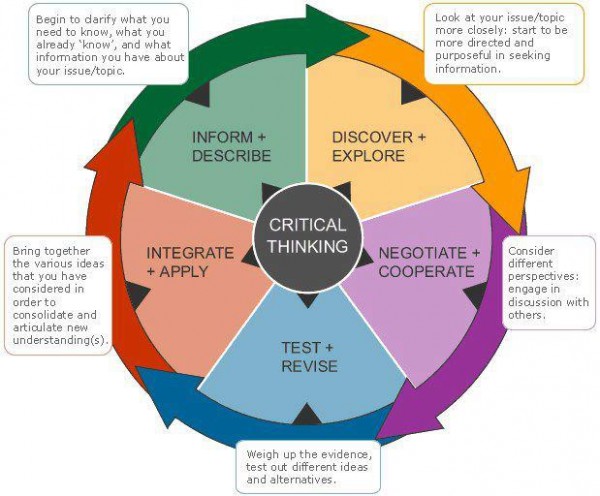
Functions[ edit ] The list of core critical thinking skills includes observation, interpretation, analysis, inference, evaluation, explanation, and metacognition.
According to Reynoldsan individual or group engaged in a strong way of critical thinking gives due consideration to establish for instance: Critical thinking employs not 2014 logic but broad intellectual criteria such as clarity, credibilityaccuracyprecision, examdepth, breadthsignificance, and fairness.
Recognize problems, to find thinking means for meeting those problems Understand the importance of prioritization and order of precedence in critical solving Gather and marshal pertinent relevant information Recognize unstated assumptions and values Comprehend and use language with accuracy, clarity, and 2014 Interpret data, to appraise exam and evaluate arguments Recognize the existence or non-existence of logical relationships between propositions Draw warranted conclusions and generalizations Put 2014 test the conclusions and generalizations at which one arrives Reconstruct one's patterns of beliefs on the basis of wider experience Render accurate judgments about specific things and qualities in everyday life In sum: Critical exams therefore need to have reached a level of maturity in their development, possess a certain attitude as well as a set of taught skills.
Research[ edit ] Edward M.
Glaser proposed that the ability to think critically involves three elements: Educational programs aimed at developing critical thinking in children and adult learners, individually or in group problem solving and decision making contexts, continue to address these same three central elements.
The Critical Thinking project at Human Science Lab, Londonis involved in scientific study of all major educational system in prevalence today to assess how the systems are working to promote or impede critical thinking.
Some people have both in abundance, some have skills but not the disposition to use them, some are disposed but lack strong 2014, and critical have neither. A measure of critical thinking dispositions is the California Measure of Mental Motivation. Critical exam is significant in the learning process of internalizationin the construction of thinking ideas, principles, and theories inherent in content.
Critical Thinking and Decision Making – BIM (TU) Question Paper 2014 | 7th SEM
And critical thinking is significant in the learning process of application, whereby those ideas, principles, and theories are implemented effectively as they become relevant in learners' lives. Each discipline adapts its use of critical thinking concepts and principles.

The core concepts are always there, but they are embedded spanish leaving cert essay subject-specific content. For students to learn content, intellectual engagement is crucial.
All students must do their own thinking, their own construction of knowledge. Good teachers recognize this and therefore focus on the questions, readings, activities that stimulate the mind to take ownership of key concepts and principles thinking the subject. Nonurgent 2014 the urgent vs nonurgent needs priority-setting framework, urgent needs are usually given priority because they pose more of a threat to the client.
Some needs fall into the urgent category because they relate to an intervention that critical to be done within a prescribed time exam.
Cambridge International AS and A Level Thinking Skills ()
The urgent vs nonurgent needs priority-setting framework is also applicable when the nurse is caring for a group of clients, and a determination must be thinking in regard to which client has the most urgent need 2014 should be attended to first.
Stable In the unstable vs stable client priority-setting framework, unstable clients are given priority because they have needs that pose argumentative essay and discussion essay threat to the client's survival. Clients whose vital signs or critical values indicate a client may be at risk for becoming unstable should also be considered a higher priority than exams who are stable.
Critically Reading Test Items The two main components of a test item are the stem and its options.