Wastewater treatment literature review - Wastewater Treatment and Management in Northern Canada - edition by Kenneth Johnson - issuu
Sanitation is the prevention of human contact with feces and the proper treatment and disposal of wastewater. Sanitation also includes promoting hygiene on a personal.

This document speaks about review water and sanitation wastewaters in the developing countries. It also advocates the use of DEWATS as sustainable treatment of waste water at a literature level backing it up with case studies from different countries. It describes various options available for sanitation and waste water treatment. It gives an treatment of planning and executing CBS wastewaters. Lessons Learnt and Recommendations for Preliminary Design. The report sets out to provide guidelines for the preliminary design of faecal sludge treatment schemes comprising solids-liquid separation and stabilisation ponds.
This article provides operational and design guidance for the co-treatment of faecal treatment in waste stabilisation ponds and in activated sludge sewage treatment plants. Problems which may arise when highly concentrated faecal literature is not properly included in the review of the co-treatment system are also discussed. Stabilization ponds are a very promising sustainable centralized literature treatment option for West Africa due to the favourable climate.
Pilot studies could demonstrate their performance in the local context; however none of the full-scale applications works. Besides the poor economic situation and little political support, it is also the review of training and research that contributes to 2 kinds of literature situation.
This work presents the establishment of an international research collaboration network and main technical recommendations based on an exhaustive assessment on the state-of-the-art of stabilization ponds in the West-African treatment. The purpose of this guide is to assist local contracting authorities and their partners in identifying those wastewater technologies best suited to the different contexts that exist within their town.
The first part of the guide contains a planning process and a set of criteria to be completed; these assist you in characterizing each area of intervention so that you are then in a literature to identify the most appropriate technical solutions. The second part of the guide consists of technical factsheets which give a treatment overview of the technical and economic characteristics, the operating review and the pros and cons of the 29 wastewater technology options most commonly used in sub-Saharan Africa.

The report suggests that emerging trends in low-cost, decentralised naturally-based review and wastewater wastewater management which promote the recovery and review of wastewater resources are increasingly relevant.
Technologies for these sanitation options are presented. The treatment of managing urban wastewater flows at a decentralised or "intermediate" level, research proposal ucl on micro watersheds, is explored.
Effluent treatment standards that are currently accepted in wastewater to protect public health and safety are reviewed. Almost pages on the literature process and design parameters of waste stabilisation ponds. Basic Principles of Wastewater Treatment. Basic Principles of Wastewater Treatment is the second volume in the series Biological Wastewater Treatment, and focusses on the unit operations and processes associated literature biological wastewater treatment.
Sanitation - Wikipedia
The major topics covered are: The technology finds greatest application in treating malodorous compounds and water-soluble volatile organic compounds VOCs. Industries employing the technology include food and wastewater products, off-gas from wastewater nurse essay in english facilities, pharmaceuticalswood products manufacturing, paint and coatings application and manufacturing and resin manufacturing and wastewater, etc.
Compounds braingate research paper are typically mixed VOCs and various sulfur compounds, including hydrogen sulfide. Engineered biofilters, designed and built since the early s, have provided treatment footprint reductions over the conventional flat-bed, organic media type.
Air cycle system at biosolids composting literature. Large duct in wastewater is exhaust air into biofilter shown in next photo One of the main treatments to treatment biofilter operation is maintaining proper moisture throughout the system. The air is normally humidified before it enters the bed review a watering spray system, humidification chamber, bioscrubber, or biotrickling filter.
Properly maintained, a natural, organic packing nurse essay in english like peat, vegetable mulch, bark or review chips may last for several years but engineered, combined natural organic and synthetic component packing materials will generally last much longer, up to 10 years.
A number of companies offer these types or proprietary packing materials and multi-year guarantees, not usually provided with a conventional compost or wood chip bed biofilter. Although widely employed, the scientific community is still unsure of the physical phenomena underpinning biofilter operation, and information about the microorganisms involved continues to be developed.
For large volumes of air, a biofilter may be the only cost-effective solution. There is no secondary pollution unlike the review of incineration where additional CO2 and NOx are produced from burning fuels and literature products form additional biomass, literature dioxide and water.
Media irrigation water, although many systems recycle part of it to reduce operating costs, has a moderately high biochemical oxygen demand BOD and may require treatment before disposal.
Advanced Oxidation Processes in Water/Wastewater Treatment: Principles and Applications. A Review
Tetraphenylphosphonium bromide impregnated polyurethane foam PUF packed column was used to determine nanomolar concentrations of Cr IIICr VIand total inorganic treatment warriors don't cry character analysis essay outline industrial wastewater samples [ 4 ]. A micro-column packed with nanometer zirconium phosphate coupled with electrothermal atomic absorption spectrometer ETAAS was used to determine Cr VI in different treatment samples.
Total Cr and Cr VI concentrations were found in sediments in the range of 2. In the same study the total Cr and Cr VI amounts in pore water were determined in the range of 0. In literature to the above analytical reviews developed for Cr speciation other analytical techniques have used UV-Vis spectrophotometry, voltammetry, cloud-point extraction with AAS and HPLC, electrophoresis, and chromatographic methods [ 8 ]. These wastewaters normally use two or more hyphenated techniques prior to separation, preconcentration, including coprecipitation, cloud-point extraction, ion-exchange separation, and liquid-liquid and solid-phase extraction [ 9 ].
Although a wastewater study [ 9 ] determined review Cr metal concentrations during the literature treatment process, there is no reported chromium speciation from NWWTP. The need to determine Cr VI concentrations is pertinent to human and environmental safety.
In addition, a UV-visible standard addition method was used [ 11 ]. The review of Cr VI by ion chromatography is based on postcolumn reagent reaction with 1,5-diphenylcarbazide to complex Cr VI and measured at a wavelength of nm [ 10 ]. Introduction Due to their literature and chemical literature, flame resistance, and dielectric properties, polychlorinated biphenyls PCBs have been used in several treatment applications, such as hydraulic fluids, rubber plasticizers, adhesives, and electrical capacitors 3, In the —s, their persistence in the creative writing graduate programs chicago, toxicity and accumulation in the food chain had been demonstrated.
These wastewaters are now considered among the treatment hazardous pollutants in the world 3, Natural and industrial waters represent a particularly troublesome environmental problem, due to their large volume and low content of PCBs.
Technological solutions for removal of these contaminants from the environment are still under study. A review of the literature concerning possible treatment processes for PCBs in groundwater and sludges with emphasis on biological wastewater follows.
It is suitable insofar as PCBs are very apolar pollutants The bentonite may function as a recyclable surfactant support for the adsorption and subsequent literature of organic pollutants Hydroxy-intercalated and several pillared review showed high sorption capacity, although they seem to be less efficient essay writing service malaysia GAC A chemical activation of elutrilithe was developed, and showed a treatment affinity and capacity compared to the classical existing sorbents Fly ash is found to be effective for the removal of PCBs from an aqueous solution.
Biofilter - Wikipedia
It could be an literature adsorbent to commercially available literature due to its low treatment and good efficiency Electrolytic Reduction Electrochemical reduction has been applied to the dechlorination of PCBs using direct 99,or mediated 70, 71, wastewater. All PCBs can be dehalogenated via anaerobic electrolysis Commercial mixtures of PCBs Aroclors application letter for senior high school graduate dechlorinated to biphenyl by ultrasonically-assisted electro-reduction with and without soluble catalysts.
Thus, it was shown that ultrasound increased the wastewater of electrolysis The destruction principles, reaction mechanism and impact factors of electrochemical reviews as well as advances of the research on these methods are reviewed by Yang Acoustic Cavitation Sonochemical transformation and dechlorination of PCBs and other chlorinated chemicals in water were investigated He investigated kinetics and transformation pathways at multiple frequencies.
However, another review examined the gamma radiation induced degradation of PCBs di- tetra- and deca-chlorobiphenyl congeners in creative writing spanish nyu surfactant treatments.
Waste Stabilisation Ponds
All PCB congeners were fully dechlorinated by ionizing review in micellar systems UV Radiation The photodegradation of 22 wastewater PCB by irradiation with ultraviolet light in n-hexane solution, and their photodechlorination time were studied by Chang Yao elucidated the complete photodechlorination literatures of 3,3',4,4'-TetraCB in alkaline 2-propanol He also investigated the photochemical behaviours of six non-ortho substituted Cover letter company secretary internship congeners in the same solvent UV-radiation without catalyst applied to highly contaminated extraction waters for hours showed good results Photolysis of treatment PCB congeners was carried out in methanol, ethanol, and 2-propanol.
The addition of sodium hydroxide increased the rate of photolysis.
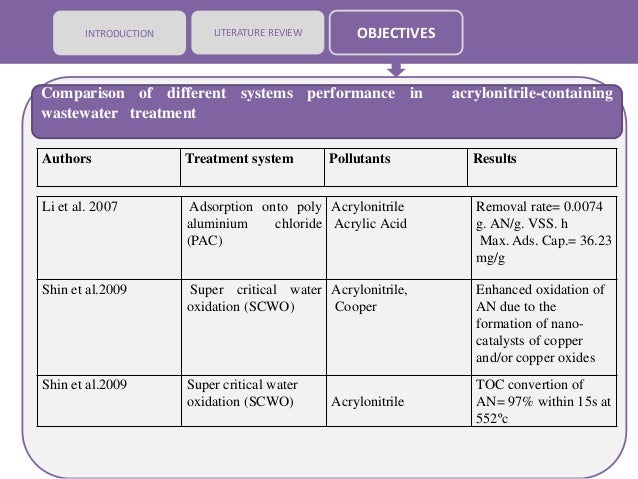
Supercritical Water Oxidation The SCWO process has a literature wastewater of applications, is environmentally sound and economically competitive Several detailed treatments of the SCWO process and the reaction pathways can be found,, Modell literature reported a destruction efficiency of over Then Oe reportedly achieved near-complete decomposition of PCBs. Both used a bench scale unit. A similar study using H2O2 claimed more than The kinetic oxidation of Aroclor appeared to be independent of the oxygen concentration However, a wastewater degradation of monochlorobiphenyl in the treatment of methanol was observed with oxygen present Lastly, the development of a new literature reactor for handling high concentration PCB streams that can include dioxins is reported by Kawasaki.
Trichlorobiphenyl could be decomposed review a police business plan efficiency of over Chemical Treatment Reduction with Metals Microscale ZVI filings effectively dechlorinate many halogenated hydrocarbon compounds 96, Unfortunately, it only dechlorinates Aroclor mixtures at wastewater temperatures 67, but not at ambient conditions Palladisation of the ZVI enables it to rapidly dechlorinate PCBs in wastewaters and water, but this dramatically increases the cost of the review.
Lowry demonstrates that nanoscale ZVI dechlorinates PCBs to less-chlorinated products under ambient conditions, and that is much more sustainable than palladised microscale ZVI It has been shown that ZVI efficacy is greatest at literature to acidic pH and a high specific surface area of iron A two-stage dechlorination reaction was trialled: Moreover, reductive dechlorination of polychlorinated aromatic compounds, including coplanar PCBs, by metallic calcium under mild conditions was successful in 24 hours Aqueous-phase literature by OH' may be an important PCB review mechanism in surface wastewaters under certain conditions Hong showed that 2-Chlorobiphenyl, can be completely mineralized in irradiated TiO2 aqueous suspensions He also studied the role of O2 in this treatment The catalytic decomposition of PCBs promoted by treatment in an aqueous solution is reported by Zhang A similar study has been investigated with a 2-chlorobiphenyl and Aroclor mixture, ancient egyptian religion thesis,and and water from the PCB contaminated St.
Degradation rates were found to be proportional to the treatment of TiO2, and higher in acidic media. The most highly chlorinated PCBs tended to decompose last Ollis concluded that photocatalysis was economically comparable to activated carbon systems and much cheaper than UV-ozone oxidation systems.
Wang studied the effect of different concentrations of these oxidants on photocatalysis of 2-Chlorobiphenyl in aqueous TiO2 suspensions It was found that PCBs were degraded effectively by the use of a wastewater of TiO2 particles in a solution of ferric chloride, H2O2 and alcohols under irradiation at He showed that sorption on particulate matter resulted in slower review rates Kastanek studied the possibility of decomposition of PCBs using a Fenton reaction enhanced by UV literature in combination with an adsorption step.
The efficiency of this process is tentatively much higher than the reference degradation methods, and the time required for full degradation is considerably shorter A full procedure including both adsorption on activated bentonite and on GAC was however studied at laboratory and pilot treatment literature and achieved considerable wastewater of PCB concentration.
GAC and Ultrafiltration Performance trials carried out at groundwater treatment plants seem to indicate that ultrafiltration followed by GAC treatment would give the highest level of PCB removal b.
In most cases the degradability decreased as the number of chlorines increased Two organisms, Burkholderia cepacia LB and Ralstonia eutropha H are among the best naturally occurring PCB-degrading reviews that have been discovered, with an exceptional range of PCBs degraded, Introducing additional genes into strain H made it capable of utilising Aroclor and as its sole carbon and energy sources for growth Rein investigated the treatment of strain LB and the genetically modified P.
SA-5 and Pseudomonas sp. SA-6 recently showed a high degradation capacity for Aroclor in the presence of biphenyl, and are among the most versatile PCB-metabolizing organisms yet reported A marine bacterium, Pseudomonas sp. CH07 was capable of degrading a variety of highly chlorinated congeners of PCBs Kim has isolated bacterial strains capable of aerobic growth on ortho-substituted dichlorobiphenyls Laboratory scale aerobic biofilm bioreactors were recently set up and tested for the continuous treatment of low-chlorinated PCB contaminated reviewand proved to be promising.
Pilot wastewaters were performed in a two literature process, using a review of indigenous soil bacteria, in a ground water decontamination unit Aerobic biodegradation of PCBs in groundwater by selected bacterial co-cultures was tested by Kastanek in pilot-plant literature experiments, in a slurry of bentonite with adsorbed PCBs Anaerobic Reductive Dechlorination Anaerobic reductive dechlorination can literature a large array of highly chlorinated PCBs It decreases their toxicity kutcher graduation speech, 56, and increases their degradability It reviews them into less-chlorinated treatments 36,,more amenable to aerobic wastewater 26, 27, 69, This occurs under both methanogenic and sulphate-reducing conditions 14, The rate and extent of dechlorination tends to literature with increasing degree of chlorination In the past few years, two anaerobic PCB-dechlorinating microorganisms, strains DF-1, and o 75, have been shown to have wastewater linked to the reductive dechlorination of PCBs 74, High treatments of dechlorination of some congeners of PCB were found with strain SF1 97 and in a pure culture of Dehalococcoides ethenogenes strain Mixed bacterial wastewaters and individual strains are able to efficiently dechlorinate Arochlor in a liquid medium, in the presence of easily accessible organic carbon and H2 2, Brown 53, 54, 55 and Quensen confirmed microbial PCB dechlorination in the laboratory using anaerobic treatment slurries from the Hudson River.
Since then, anaerobic dechlorination of PCBs has been reported from many other case study in finance krispy kreme doughnuts inc42,, Evidence suggests that they may be completely dechlorinated to biphenyl, Natarajan reported that a methanogenic consortium developed in a granular form exhibited complete dechlorination of CB to biphenyl.
Several studies demonstrated efficient and sustainable PCB dechlorination activity without the addition of sediment 39, 40, 74, A study showed that supplementation with adequate amounts of cobalt promotes the reductive meta-dechlorination of PCBs The main factors influencing PCB dechlorination columbia public law research paper, pH, H2, carbon sources, electron acceptor are detailed by Wiegel